

Depositary Banking
BankTech at Nexus 2026: how collaboration is shaping the future of depositary banking
Published on 10 June 2026
Discover how ABBL, CACEIS and Depowise explored the future of depositary banking at Nexus Luxembourg 2026, highlighting the role of collaboration, fintech innovation and operational efficiency.
Summary
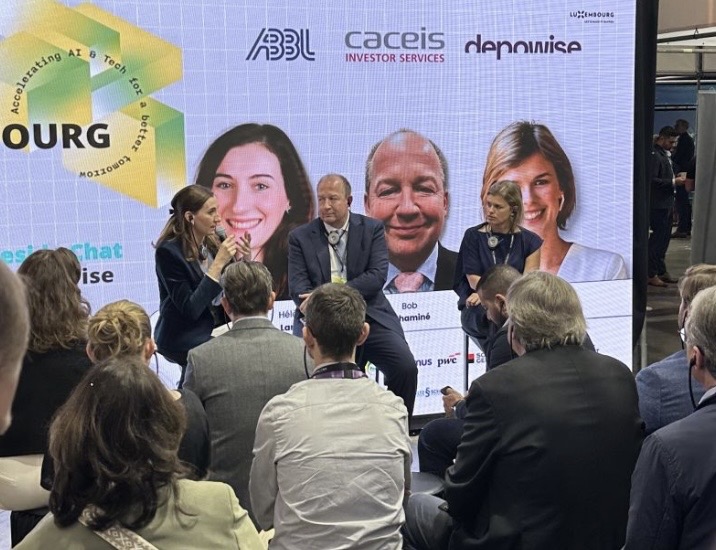
At Nexus Luxembourg 2026, ABBL brought together industry leaders and innovators for a fireside chat exploring one of the most pressing questions facing financial institutions today: how can banks and fintechs work together to accelerate innovation while meeting increasingly complex operational and regulatory requirements?
Hosted at the LHoFT booth, the discussion featured Hélène Lange, Head of Business Coordination at ABBL, Bob Schaminé, Group Head of Global Depositary Entities at CACEIS, and Mélanie Moos, CEO of Depowise, winner of the first ABBL-LHoFT BankTech programme.
Their discussion highlighted a growing reality across the financial sector: innovation is no longer driven by technology alone. Sustainable progress emerges when financial institutions, fintechs and industry organisations work together to address concrete business challenges.


My experience at Catapult BankTech reinforced one conviction: the future of depositary banking will not be built by banks or fintechs independently, but through the partnerships they create together!
Hélène Lange
Head of Business Coordination, ABBL
 Turning industry challenges into opportunities
Launched in 2025 by ABBL and the LHoFT, the Catapult BankTech programme was designed to address a specific need within the depositary banking sector. Rather than asking fintechs to showcase their solutions, participating banks were invited to identify real operational challenges and areas where innovation could create tangible value.
For CACEIS, the programme provided an opportunity to explore solutions to several key industry challenges, including increasing operational efficiency, improving data management and strengthening oversight processes in an increasingly complex regulatory environment.
According to Bob Schaminé, what differentiated BankTech from traditional fintech engagement was its structured and collaborative approach. Instead of isolated pitches, the programme created a framework that enabled meaningful dialogue between banks and solution providers, helping both sides better understand each other’s constraints, expectations and opportunities.
The result was not simply a showcase of technology, but a process focused on validating practical use cases and identifying solutions capable of delivering measurable impact.

Catapult BankTech provided a unique platform to engage with fintechs genuinely committed to understanding the complexities of depositary banking and co-creating solutions to address our most pressing business challenges.
Bob Schaminé
Group Head, Global Depositary Bank Entities at CACEIS and member of the ABBL Depositary Banking Cluster
A fintech perspective on innovation
For Depowise, participation in BankTech represented an opportunity to engage directly with decision-makers from Luxembourg’s banking community.
The company specialises in automating depositary oversight and control processes, helping financial institutions reduce manual workloads, improve data quality and strengthen risk management. These challenges resonate strongly across the asset servicing industry, where growing regulatory expectations continue to increase operational complexity.
As Mélanie Moos explained during the discussion, one of the programme’s greatest strengths was the direct access it provided to banking professionals. These exchanges offered valuable insights into the day-to-day realities faced by depositary institutions and helped refine the company’s understanding of market needs.
Winning the first edition of the programme alongside Altilia was an important milestone for Depowise. However, the real value has been the momentum generated afterwards. The visibility gained through BankTech has accelerated conversations with industry stakeholders and reinforced the company’s ambitions in Luxembourg, one of Europe’s leading fund servicing centres.
 Luxembourg’s collaborative advantage
A recurring theme throughout the conversation was the unique strength of Luxembourg’s financial ecosystem.
Both speakers highlighted the openness of market participants and the willingness of institutions to engage constructively with new ideas. In a sector where trust, expertise and regulatory compliance are critical, collaboration remains a powerful enabler of innovation.
For CACEIS, the experience reinforced the value of working with fintechs as strategic partners capable of bringing fresh perspectives and specialised expertise. For Depowise, Luxembourg stood out for its accessibility, concentration of decision-makers and strong culture of cooperation between financial institutions, fintechs and industry bodies.
Building the future together
As the financial sector continues its digital transformation, initiatives such as BankTech demonstrate how innovation can be accelerated when institutions work together around shared challenges.
The success of the programme’s first edition confirms that the future of financial services will be shaped not by banks or fintechs acting independently, but by the partnerships they build together.
By creating a platform where established financial institutions and innovative technology providers can collaborate on real-world challenges, BankTech is helping to strengthen Luxembourg’s position as a leading European hub for financial innovation, digital transformation and next-generation asset servicing.

Hélène Lange
Head of Business Coordination, ABBL
Published on 10 June 2026