

ABBL Institutional
Cheap credit, big ambitions: why banking competitiveness matters
Published on 10 August 2026
Luxembourg businesses currently enjoy the lowest average borrowing costs in the euro area. As Brussels puts banking competitiveness firmly on its agenda, this is more than a flattering statistic. It offers a glimpse of what is at stake: ensuring that Europe’s banks can finance more of the investment the continent needs.
Summary
 Europe has no shortage of investment ambitions. Financing them is another matter.
The green and digital transitions, defence, infrastructure and new technologies will require investment on a scale Europe has not seen for decades. Estimates now put additional annual investment needs at up to €1.4 trillion.
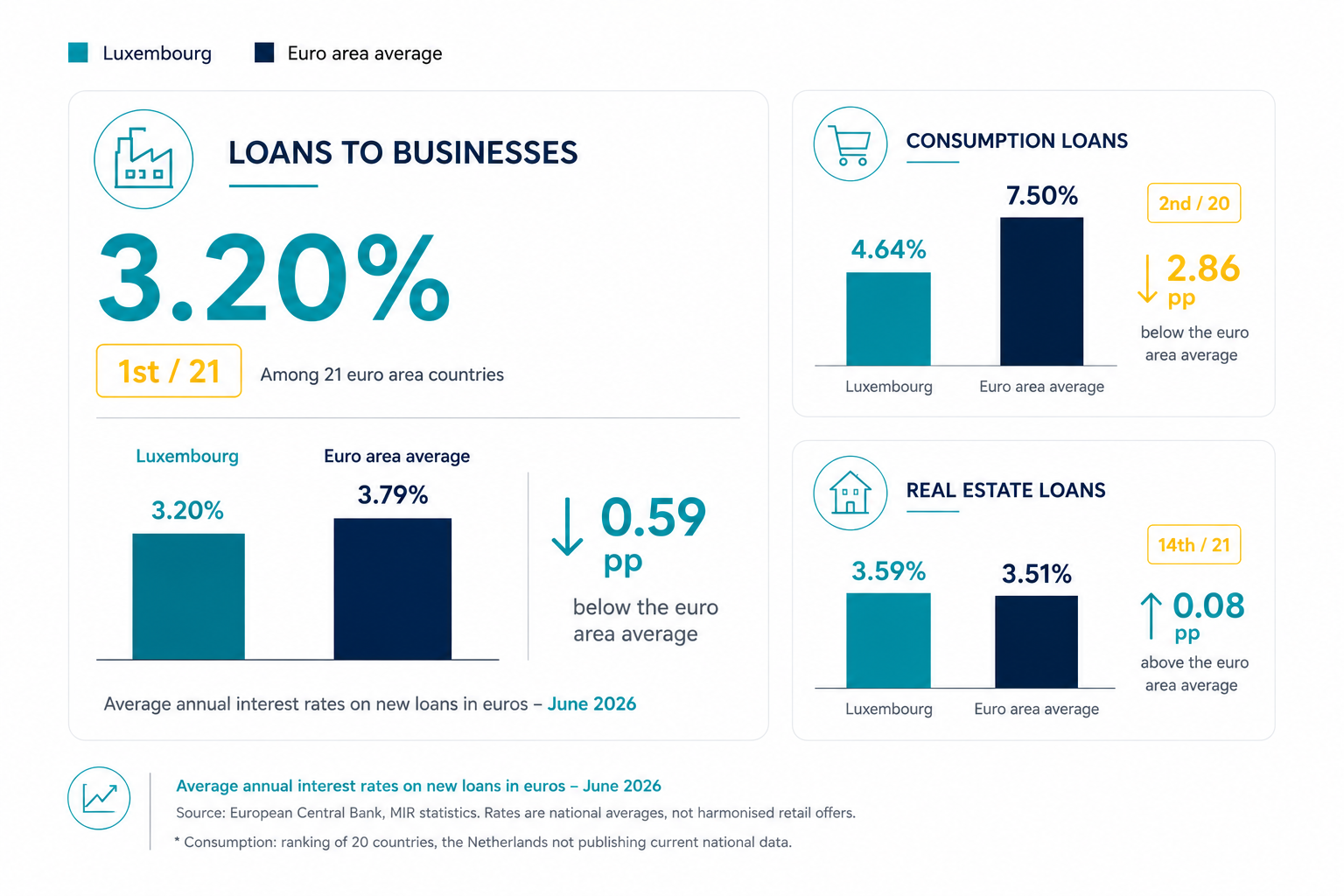
Against that backdrop, a seemingly mundane piece of interest-rate data deserves attention. According to the latest ECB figures, the average rate on new business loans in Luxembourg stood at 3.20% in June 2026, the lowest among the 21 countries surveyed and 59 basis points below the euro-area average.
A single month does not make a trend. Nor are lending rates a simple measure of banking competitiveness: they reflect the characteristics of borrowers and loans, collateral, market structure and competition.
But the Luxembourg figure illustrates something more fundamental. Competitive banks matter because competitive financing matters.
And Brussels increasingly appears to agree.
 A change in the European debate
The European Commission’s recent Communication on banking competitiveness marks an important shift. After more than a decade in which European banking policy was understandably dominated by resilience and financial stability, competitiveness is now explicitly part of the equation. The Commission also recognises the essential role banks have to play in financing Europe’s strategic priorities, from the green transition and clean technologies to defence and artificial intelligence. More information here
That does not mean undoing the safeguards built since the financial crisis. It means asking a different question: how can a resilient banking system put more of its strength to work for Europe’s economy?
The distinction matters. Europe’s banks are well capitalised, yet the continent simultaneously faces an enormous financing gap. Bank lending capacity is closely linked to the capital banks have available. The European Banking Federation and Oliver Wyman estimate that banks would need around €150 billion in additional available capital to finance just 20% of Europe’s additional private investment needs over the next five years.
The policy challenge is therefore no longer simply to accumulate resilience, but to ensure that capital, liquidity and resources can be deployed efficiently to support productive investment.
 From diagnosis to delivery
The diagnosis is increasingly shared. The task now is delivery.
The Commission has opened the door to reforms in areas ranging from the complexity of the capital framework and proportionality to supervisory practices, reporting requirements and the treatment of software investments. For Luxembourg’s banking sector, these are important signals. The ABBL has consistently argued for a stable and predictable prudential framework, effective proportionality and a reduction of unnecessary cumulative regulatory burdens.
This is not about choosing competitiveness over financial stability. Nor is simplification an end in itself. The objective should be to ensure that regulation focuses resources on managing genuine risks while allowing banks to devote more capacity to customers, investment and innovation.
The cumulative effect matters. Capital requirements, reporting obligations, supervisory expectations and overlapping European and national rules all influence how banks allocate scarce financial and human resources. Better calibration can therefore help strengthen their ability to finance the economy without weakening the resilience built over the past decade.


Competitiveness and resilience are not opposing objectives. Europe has built a strong banking system over the past decade. The challenge now is to ensure that this strength can be put to work to finance businesses, innovation and Europe’s strategic ambitions.
Jerry Grbic
CEO, ABBL
 Making the Single Market work like one
Capital is only part of the story.
One particularly important aspect of the Commission’s analysis is its recognition that fragmentation in European banking goes well beyond prudential regulation. Differences in areas including civil and insolvency law, taxation, data protection, consumer protection and anti-money laundering continue to impede cross-border activity.
For an international financial centre such as Luxembourg, this matters greatly. A European passport can only deliver its full benefits if financial institutions do not have to redesign products, contracts, IT systems and operational processes each time they cross a national border.
Greater integration should also make it easier for capital and liquidity to move efficiently within European banking groups, while maintaining appropriate safeguards. Combined with deeper capital markets, this could help ensure that financial resources flow towards the investments that need them most.
This is also why presenting banks and capital markets as competing models misses the point. Europe needs both. Stronger securitisation markets, for instance, can allow banks to transfer risk and recycle capital into new lending, while giving institutional investors access to assets suited to their investment needs.
A more integrated financial system should create a financing continuum, with banks, capital markets, institutional investors and public financing reinforcing rather than replacing one another.
 Competitiveness serves the economy
Luxembourg’s 3.20% borrowing rate is only a snapshot. But it helps make an abstract debate tangible.
When financing is competitive, businesses have more room to invest, innovate and grow. Banks with sufficient lending capacity can accompany companies through the green and digital transitions. Deeper capital markets can help recycle that capacity. And simpler, more proportionate and more consistent rules can allow financial institutions to devote more resources to financing their customers.
The Commission has now recognised that banking competitiveness is part of Europe’s wider competitiveness challenge. That is an important step.
The next one will be harder: translating that recognition into concrete reforms that simplify the framework, improve proportionality, reduce fragmentation and allow capital to flow where it can finance productive investment.
The reactions to the Commission’s Communication across the European banking industry make clear that speed and implementation will now be decisive.
Europe has spent more than a decade building a resilient banking system. It should preserve that achievement. But resilience is not an end in itself. Its economic value lies in putting that strength to work, financing Europe’s businesses, households and ambitions.
Luxembourg’s latest lending figures offer a small but telling illustration of what that can mean.

Jerry Grbic
CEO, ABBL
Published on 10 August 2026