

Law, Tax, Compliance
Luxembourg moves to strengthen its lending toolkit
Published on 17 August 2026
Bill of Law 8813 would give funded sub-participations greater legal certainty, helping lenders share risk, preserve lending capacity and reinforce Luxembourg’s position as an international financing centre. The proposal follows dialogue between the Ministry of Finance and market stakeholders, including the ABBL and its members.
Summary
Some financial reforms arrive with hundreds of pages of rules. Luxembourg’s latest one takes just three articles.
Its potential significance is rather larger.
On 30 July 2026, Finance Minister Gilles Roth submitted Bill of Law 8813 on the protection of funded sub-participation agreements (conventions de sous-participation en trésorerie) to Parliament. The proposal introduces a dedicated legal regime designed to protect participants against the insolvency risk of Luxembourg lenders.
The reform addresses a technical issue, but one with wider implications for the competitiveness of Luxembourg’s financing market.
The ABBL, working closely with its members, contributed to the discussions with the Ministry of Finance that helped bring the proposal forward. The bill’s official impact assessment confirms that the ABBL was among the stakeholders consulted during its preparation.


This proposal shows what constructive dialogue between the public authorities and the financial sector can achieve. By addressing a concrete legal uncertainty identified by the market, Luxembourg can strengthen both the protection of participants and the ability of lenders to manage risk efficiently.
Jonathan HUG
Head of Legal, Tax and Compliance
 A useful instrument, with an awkward weakness
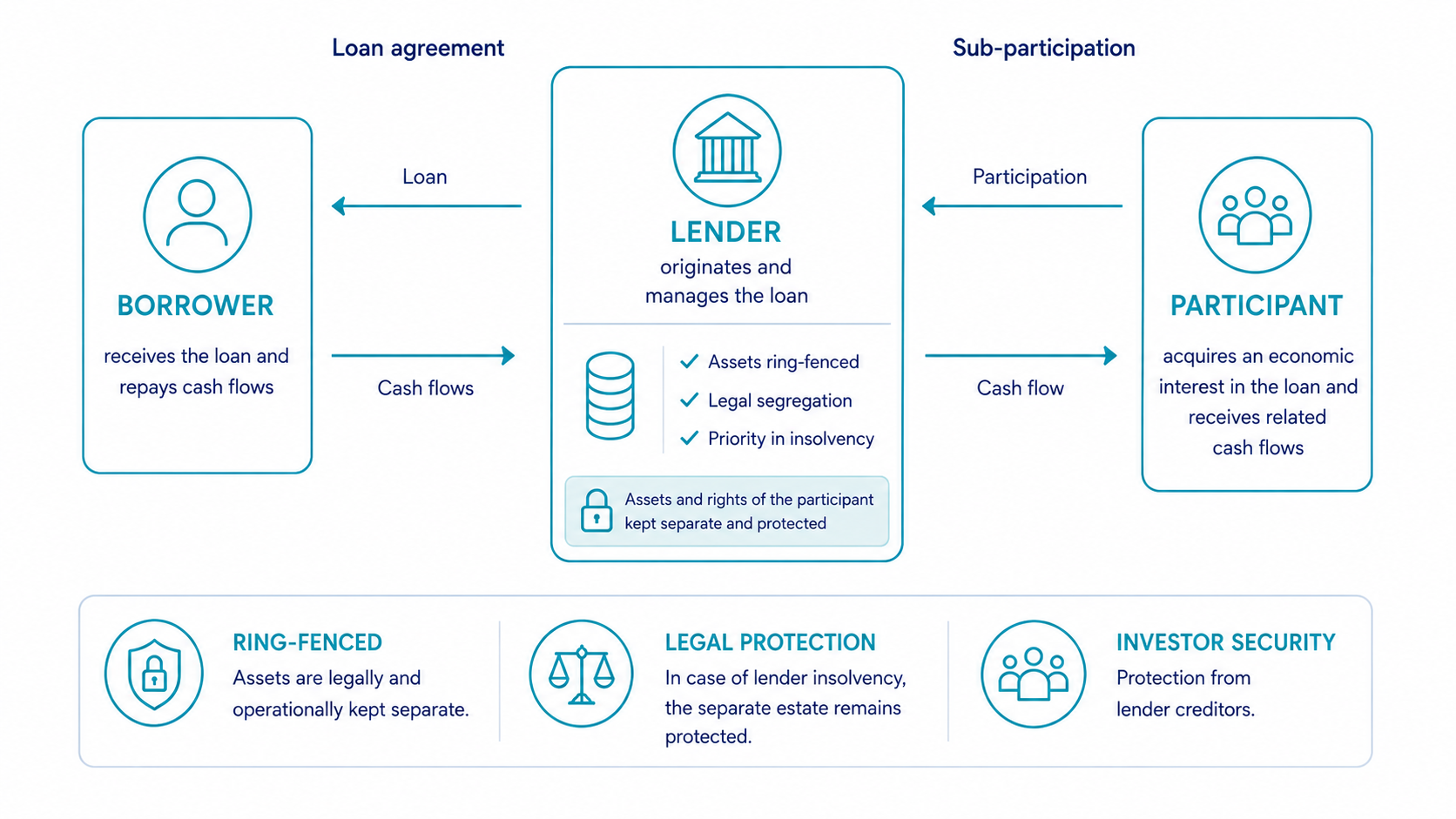
Funded sub-participations allow lenders to share the risk associated with a loan without transferring the underlying loan itself.
In simplified terms, a participant provides funding to a lender and, in return, becomes entitled to a corresponding share of the payments received by that lender from the borrower.
For banks and other lenders, this is useful. Rather than selling a loan outright, and potentially having to transfer associated security arrangements and alter the direct relationship with the borrower, they can use sub-participation to distribute part of the risk while remaining the borrower’s contractual counterparty. The Government describes these arrangements as an important tool for risk management and indirect bank syndication.
There is, however, a catch.
Because the participant has no direct claim against the underlying borrower, it is exposed not only to the borrower’s credit risk but also to the lender itself. Under the current framework, if that lender becomes insolvent, the participant may find itself treated as an ordinary unsecured creditor.
That additional counterparty risk can make an otherwise useful financing technique less attractive.
 Ring-fencing the participant’s assets
Bill 8813 proposes a relatively straightforward answer.
Assets owed by a Luxembourg lender under a qualifying funded sub-participation, together with the related contractual obligations, would form a separate fiduciary estate, or patrimoine d’affectation, for the benefit of the participant.
They would therefore sit outside the lender’s general estate and be protected against claims from its other creditors. The lender’s obligation to transfer those assets to the participant would also remain unaffected by reorganisation, insolvency proceedings or other competing creditor situations.
The practical change is important: the participant would no longer depend solely on the lender’s general solvency for the relevant assets and cash flows.
The proposal also has implications under the bank recovery and resolution framework. The explanatory memorandum concludes that, where the relevant conditions are satisfied, liabilities arising from these funded sub-participations would constitute liabilities arising from a fiduciary relationship and therefore fall outside the scope of the BRRD bail-in tool. The wider resolution framework would continue to apply.
Legal analyses published since the bill was tabled have similarly highlighted the significance of the proposed statutory segregation mechanism for participant protection.
 More than insolvency protection
The reform matters beyond the lawyers drafting the agreements.
Sub-participations allow lenders to share risk and free up regulatory capital, helping preserve their capacity to originate new loans. They can also avoid some of the complexity involved in transferring the underlying loan and associated security to another creditor.
That makes legal certainty around the instrument relevant to a much broader policy question: how effectively can Luxembourg’s financial system put capital to work?
The Government itself makes the competitiveness objective explicit. Its explanatory memorandum says the reform is intended both to strengthen Luxembourg’s attractiveness in the secondary loan market and to support the development of loan origination by Luxembourg lenders.
The scope is deliberately broad. Although Luxembourg credit institutions are an obvious constituency, the proposed regime may also apply to other Luxembourg entities acting as lenders, including professionals of the financial sector and loan or debt funds. Natural persons are excluded. Importantly for an international financial centre, the regime is intended to operate irrespective of the law governing the underlying sub-participation agreement.
A&O Shearman notes that this could make the regime relevant across loan, private credit and structured-finance markets, particularly for cross-border structures involving Luxembourg lenders.

Legal certainty, without unnecessary rigidity
The bill also leaves room for contractual freedom.
If adopted in its current form, the regime would apply automatically to funded sub-participations concluded after the law enters into force, but parties could choose to opt out.
Existing agreements would work the other way around: they would remain outside the new regime unless the parties decided to opt in.
This distinction is particularly relevant for an international market in which contracts may be governed by foreign law and existing structures should not be disrupted unnecessarily.
It also illustrates the broader philosophy behind the proposal: improve protection and predictability while preserving contractual flexibility.
A small reform with a wider message
There is a temptation to measure financial-sector reform by its size. Bill 8813 suggests another metric: whether a rule solves an identifiable problem.
Here, the problem is narrow. Participants in funded sub-participations face an additional layer of counterparty risk because the lender remains between them and the underlying borrower. The proposed solution is equally targeted: legally segregate the relevant assets and give participants greater protection if the lender fails.
But the economic logic reaches further.
For Luxembourg, competitiveness as a financial centre depends partly on having a legal framework capable of accommodating sophisticated international financing transactions with sufficient certainty. Removing unnecessary legal friction can make risk easier to distribute, capital easier to deploy and lending structures more attractive.
That is why the dialogue behind the proposal matters too. The ABBL and its members brought market expertise into discussions with the Ministry of Finance, helping translate an operational issue into a concrete legislative proposal. The Government’s impact assessment formally records the ABBL among the stakeholders consulted.
Bill 8813 must now proceed through the legislative process. It was submitted on 30 July and assigned to the Chamber of Deputies’ Finance Committee.
For what is, on paper, a three-article bill, it could prove a useful addition to Luxembourg’s financing toolkit.