

Digital, Innovation, Payments
LHC Cyberfraud Award: how a Luxembourg solution is helping stop fraud earlier
Published on 29 October 2026
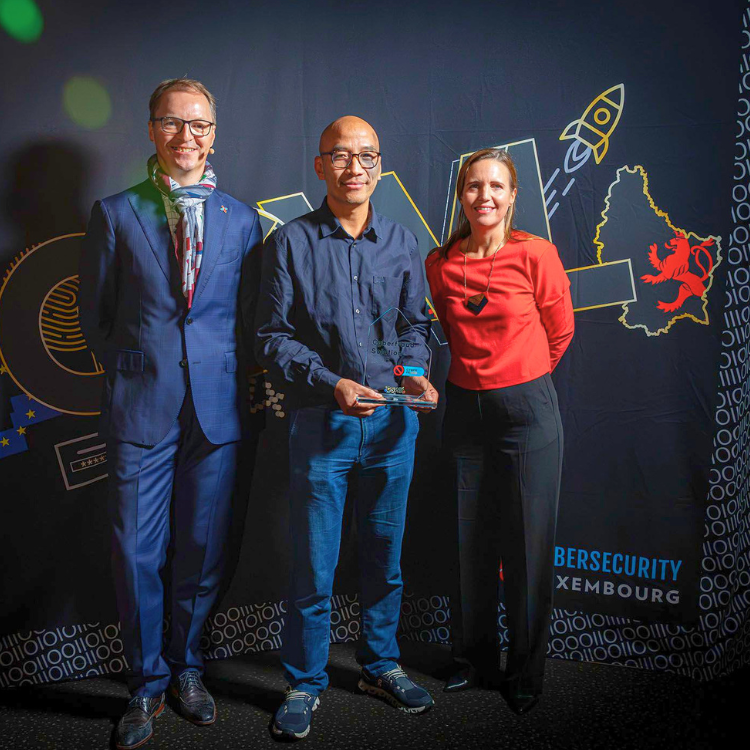
The Cyberfraud.lu Solution of the Year Award, led by the Luxembourg House of Cybersecurity, recognises concrete and proven solutions developed in Luxembourg to prevent, detect and combat cyberfraud. This year’s winning solution from POST Group shows what that impact can look like in practice.
In this interview, Pascal Steichen, Cu D. Nguyen, Ph.D., and Ananda Kautz discuss the purpose of the Award, how POST’s anti-phishing solution works and why closer cooperation between banks, telecom operators, cybersecurity specialists and public authorities is key to protecting customers.
Summary
 Cyberfraud rarely starts with the payment itself. Fraudulent SMS, spoofed identities and other forms of social engineering can reach customers well before a financial institution sees any suspicious transaction.
This is why effective fraud prevention increasingly depends on cooperation across the wider digital ecosystem.
The Cyberfraud.lu Solution of the Year Award puts this approach into practice by recognising concrete solutions developed in Luxembourg that help prevent, detect and combat cyberfraud.
We spoke to Pascal Steichen, CEO of the Luxembourg House of Cybersecurity, Cu D. Nguyen, Ph.D., Engineering and Research Lead, TelcoSec Team/CyberForce Department at POST Group, and Ananda Kautz, Member of the Management Board at the ABBL about the winning solution and what it tells us about the next steps in the fight against cyberfraud.


Fraud often starts before a payment, so protection must involve the whole chain.
Ananda Kautz
Member of the Management Board of the ABBL
 Pascal, what kinds of solutions does the Cyberfraud.lu Solution of the Year Award aim to encourage and bring to wider attention?
Pascal Steichen:
The Cyberfraud.lu Solution of the Year Award aims to recognise, promote and showcase concrete, proven solutions developed in Luxembourg that contribute to preventing, detecting and combating cyberfraud.
Through the national cyberfraud.lu platform, all eligible solutions will be highlighted, helping to create a strong local solutions base for Luxembourg.
Ultimately, the Award is not about recognising the most technologically advanced solution, but about celebrating those that deliver meaningful, practical impact and make a tangible difference in people’s everyday digital lives.
Cu, a text message appears to come from a bank or delivery service. How does POST’s solution prevent a fraudulent message from reaching its recipient?
Cu D. Nguyen, Ph.D.:
Our solution runs directly in POST’s telecom core network, detecting malicious SMS in near real time.
When criteria set by our experts are met — such as a sender spoofing a known bank combined with volume and severity thresholds — automation blocks further messages from that sender within seconds.
In 2026 alone, it detected more than 5.7 million malicious SMS and blocked around 90% of them from reaching POST mobile subscribers.
POST’s Anti-Phishing managed service builds on this capability by adding takedowns, browser protection, DNS-level blocking and reporting.
Ananda, this example shows that fraud prevention can start well before a banking transaction takes place. How do banks, telecom operators and public bodies work together in Luxembourg?
Ananda Kautz:
Fraud often starts before a payment, so protection must involve the whole chain.
Through our Trust and Cybersecurity Working Group, the ABBL brings banks together to share expertise. Our cooperation extends to telecom operators, cybersecurity specialists and public authorities.
This approach led the ABBL and our Foundation for Financial Education to initiate cyberfraud.lu alongside the Luxembourg House of Cybersecurity.
POST’s solution demonstrates the benefit: a telecom operator can stop an attack before the customer’s bank becomes aware of it.
Pascal, what makes this cooperation effective, and how does it translate into joint initiatives such as cyberfraud.lu?
Pascal Steichen:
What made this initiative particularly valuable was the genuine willingness of all institutional actors around the table to work together towards a common goal.
By joining forces and creating synergies to combat cyberfraud while leveraging each other’s services and areas of expertise, we have realised the huge potential of providing better and more appropriate support to users.
Building on this common objective, we mapped the available support mechanisms and worked together to develop a clearer support journey for users, ensuring they can be directed to the right organisation at the right time.
This collaborative approach has helped lay the foundations for a more coordinated, accessible and effective response to cyberfraud in Luxembourg.
Cu, how did the idea for this solution emerge at POST, and how have exchanges with other organisations helped develop it?
Cu D. Nguyen, Ph.D.:
Telecom networks date back to the 1970s, when security was barely considered, and some of those technologies are still in use.
Our assessments in 2018 showed that existing products fell short; none addressed SMS phishing, a recurring problem in Luxembourg.
So we built our own solution from scratch, drawing on our field experience as an operator.
As one of the most active members of GSMA information-sharing initiatives, POST also benefits from exchanges that lead to new training data and better attack intelligence, helping to improve the solution over time.
Ananda, what does POST’s solution tell us about Luxembourg’s ability to develop innovations that deliver value beyond its domestic market?
Ananda Kautz:
POST shows how expertise developed to address a local operational challenge can become internationally relevant technology.
Its partnership with Ericsson around the TIDS platform illustrates that potential.
Luxembourg combines an international financial centre, telecom expertise and close connections between businesses and public institutions. These connections help identify practical needs and develop solutions with wider applications.
For the ABBL, this demonstrates how innovation made in Luxembourg can strengthen both digital security abroad and our country’s competitiveness.
What concrete step should we take together next to better protect individuals and businesses against online fraud?
Cu D. Nguyen: share more information
Cu D. Nguyen, Ph.D.:
Sharing more would be our priority.
Our solution runs only on our own telecom network, but we are willing to share information via MISP so that other operators can, and should, take action to block malicious SMS passing through their networks.
In this way, everyone benefits from better protection.
In the other direction, we have also deployed a small data-collection platform, accessible at tids.post.lu/smstext, where individuals and businesses in Luxembourg can easily share the malicious SMS they receive, helping to keep our detection up to date.
Ananda Kautz: shorten the time between detection and action
Ananda Kautz:
Our priority should be to shorten the time between detecting fraud and taking coordinated action.
Sharing information through tools such as MISP must translate into faster blocking, takedowns and warnings.
This requires clear contacts and agreed procedures between banks, telecom operators, cybersecurity specialists and public authorities.
Alongside this operational cooperation, we must make support easier to navigate. Cyberfraud.lu provides a foundation: people need to know immediately what to do, who to contact and which evidence to preserve.
Tackling cyberfraud requires coordinated action by banks, telecom operators, cybersecurity specialists and public authorities, supported by a clear framework for information sharing.
The Cyberfraud awards showcase that integrating telecom signals into fraud prevention clearly helps combat fraud.
Cyberfraud.lu complements these efforts by helping fraud victims understand what steps to take, whom to contact and what evidence to preserve.
Pascal Steichen: strengthen the collective response
Pascal Steichen:
A coordinated response to cyberfraud will strengthen our collective impact.
It is therefore essential that authorities, public- and private-sector organisations continue to work closely together, sharing their initiatives, exchanging expertise and identifying opportunities to further enhance their cooperation.
As fraud continues to evolve, so too must our preparedness and response.

Ananda Kautz
Member of the Management Board of the ABBL
Published on 29 October 2026