

Education & Training
How financially literate are Luxembourg residents?
Published on 20 December 2023
The OECD/INFE survey reveals significant financial literacy gaps in Luxembourg, especially among young residents, reinforcing the need to strengthen financial education from an early age.
Summary
A recent survey conducted in 39 countries on behalf of the OECD/International Network on Financial Education (INFE) highlighted the points of attention related to the financial culture level of the Luxembourg residents. These results are striking! More than ever, we need to strengthen financial education initiatives to better educate financially the general public and this as early as possible.
This was the first time that Luxembourg took part in the OECD/INFE survey on financial culture aiming to measure the financial knowledge, attitudes (prudence or casualness) and behaviour (budgeting, using online banking). The data for Luxembourg have been provided by the ABBL Foundation for Financial Education and the CSSF, which had commissioned ILRES to collect all the required information at the beginning of the year.
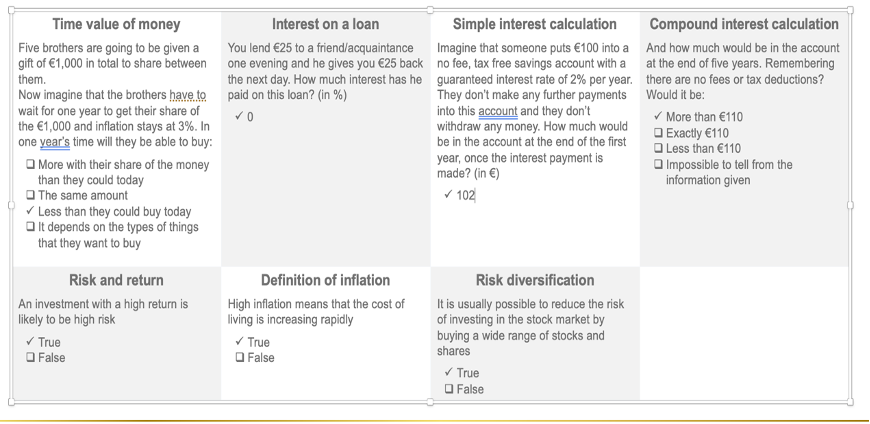
The level of financial knowledge of young Luxembourg residents is below average
The ranking of the youngest (aged 18 to 29) is quite alarming. They score below the OECD average of young people surveyed, ranking 24th.
Digital natives not so comfortable
The results for young Luxembourgers in terms of digital financial literacy are also worrying. With a score of 52 out of 100, their are lower than the results of the global Luxembourg population and the OECD average for the same age group.
This low score can certainly be explained by a certain casualness linked to the general well-being of Luxembourgish households, combined with a fairly low level of vigilance explained by the fact that this population has grown up in a digital world and tends to be less aware about security or personal data protection.
The ABBL Foundation and the CSSF are calling for educational initiatives
To take into account the economic (inflation), societal (unemployment rate) and financial developments (digitalisation), the national strategy for financial education was recently updated by the CSSF and the ABBL Foundation, with the support of an ad hoc working group. As well as mentioned in the initial strategy (published in 2015), one of the main recommendations is to introduce financial education into school curricula. We remain optimistic after reading in November that the government coalition agreement announced its intention to introduce measures to improve financial education for all citizens, in particular through basic financial education in primary and secondary schools! The inclusion of financial education in the school curricula in Luxembourg is one of their long-standing demands.
The ABBL Foundation and the CSSF are of course willing to collaborate with the Ministry of Education and the Ministry of Finance on this matter. The Foundation has a certain expertise in setting up projects in this field. Among other things, it initiates training sessions and workshops for children, teenagers and adults. This year, the Foundation also launched a mobile app, Money Odyssey, the content is based on the recommendations of the OECD and the European Commission Financial Competence Framework for adults and children.
Finally, it should be remembered that according to a survey published in March 2023 by the Foundation among more than 700 young people aged between 15 and 21, “88% consider that financial education is necessary from school onwards”.
Jessica Thyrion
Adviser – financial education, ABBL
Published on 20 December 2023