

ABBL Institutional
IMF report points to a new growth model for Luxembourg
Published on 06 July 2026
The IMF’s latest assessment highlights why Luxembourg’s future prosperity will depend on productivity, innovation, private investment and a competitive financial ecosystem.
Summary
Each year, the International Monetary Fund’s Article IV consultation offers one of the most comprehensive assessments of Luxembourg’s economy. Earlier this spring, the IMF’s experts met with government officials, public institutions and representatives of the private sector, including the ABBL, to discuss the country’s economic outlook and the reforms needed to sustain long-term prosperity.
The resulting report is more than a health check of the Luxembourg economy. It signals a broader shift in thinking about where future growth will come from.
For many years, Luxembourg successfully navigated successive crises through strong public finances, a resilient financial sector and decisive public intervention. The IMF’s latest assessment suggests that the next phase of economic development will require a different engine: a stronger, more productive and more innovative private sector.
Key messages
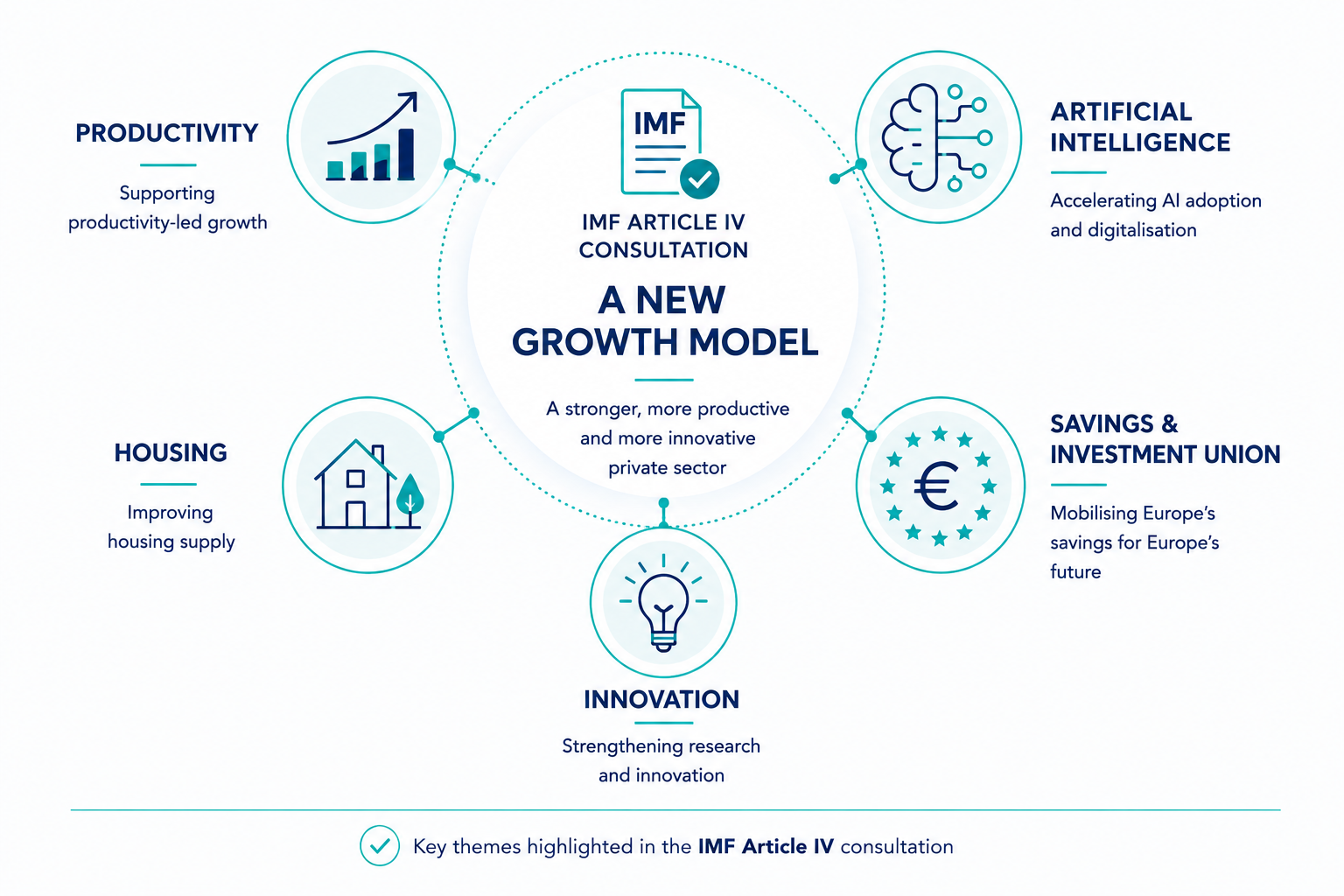
The IMF identifies five priorities for Luxembourg’s future growth:
- Increase productivity
- Accelerate digitalisation and AI adoption
- Foster innovation and entrepreneurship
- Address housing constraints
- Deepen European financial integration
 From resilience to renewal
The report leaves little doubt about Luxembourg’s strengths. Public debt remains among the lowest in Europe. The financial sector has demonstrated remarkable resilience despite heightened geopolitical uncertainty and continued volatility in international markets.
Yet the IMF also points to a more structural challenge. Economic growth has become less dynamic, productivity has stalled, labour shortages have intensified and housing constraints increasingly limit the country’s ability to attract and retain talent.
The conclusion is not that Luxembourg has become less resilient. Rather, resilience alone is no longer sufficient.
The country’s next growth story will depend on its ability to unlock productivity, encourage entrepreneurship, foster innovation and create an environment in which private investment can flourish.


Many of these themes featured prominently during the ABBL’s discussions with the IMF delegation and have long been at the heart of the Association’s advocacy, whether through calls for a more competitive business environment, greater investment in innovation and artificial intelligence, reduced regulatory complexity, improved housing supply or deeper European financial integration.
Sandrine Roux
Secretary General, ABBL
 A stronger private sector as the next growth engine
Perhaps the report’s most important message is that Luxembourg’s future prosperity will depend increasingly on the dynamism of its private sector.
The IMF advocates reforms that encourage productivity-led growth: accelerating digitalisation and AI adoption, strengthening research and innovation, improving access to finance for growing companies, simplifying administrative procedures and investing in the skills required by tomorrow’s economy. Housing also features prominently, reflecting its growing importance as both an economic and competitiveness issue.
Taken together, these recommendations outline a coherent strategy, not one centred on short-term stimulus but on enabling businesses to invest, innovate and grow over the long term.
Key takeaway
The IMF’s latest assessment suggests that Luxembourg’s next phase of growth will depend less on public intervention and increasingly on productivity, innovation and a competitive private sector.
 Mobilising Europe’s savings for Europe’s future
If the private sector is expected to play a greater role, then the financial ecosystem becomes part of the solution.
Europe faces unprecedented investment needs. Financing the green transition, strengthening defence capabilities, modernising infrastructure, accelerating digitalisation and supporting innovation will require enormous volumes of long-term capital over the coming decades. Public resources alone will not be sufficient.
This is where Luxembourg’s financial ecosystem has a unique contribution to make.
Banks, investment firms, payment institutions, fintech companies, asset servicing specialists and the many legal, consulting and auditing firms that support them all perform the same essential economic function: transforming savings into productive investment.
That is also why the IMF places particular emphasis on completing the European Single Market for services and advancing the Savings and Investment Union. For Europe, these initiatives are about mobilising capital more efficiently. For Luxembourg, they also represent an opportunity to reinforce its role as one of Europe’s leading international financial centres and a gateway for cross-border investment.
 A shared direction of travel
While individual policy recommendations will naturally remain the subject of debate, the broader direction outlined by the IMF is striking.
Across many of the issues that will shape Luxembourg’s future—from productivity and innovation to skills, housing, simplification and European integration—a growing consensus is emerging that long-term prosperity will depend less on expanding public support than on creating the conditions in which private initiative can thrive.

Europe does not suffer from a lack of savings. It suffers from a shortage of investment. Bridging that gap is one of the defining economic challenges of this decade. Luxembourg has built an ecosystem that transforms capital into growth, innovation and jobs. Preserving its competitiveness is therefore not only in Luxembourg’s interest; it is also in Europe’s.
Jerry Grbic
CEO, ABBL
A strategic opportunity
The significance of this year’s IMF consultation lies not only in its assessment of Luxembourg’s current performance, but also in the direction it points towards.
The challenge is no longer simply to preserve an economic model that has served the country well. It is to adapt that model to a world where productivity, innovation and private investment will increasingly determine competitiveness and long-term prosperity.
For the ABBL, the consultation also demonstrated the value of an open dialogue between international institutions, policymakers and the financial ecosystem. The fact that many of the priorities discussed during those exchanges are reflected in the Fund’s final assessment reinforces a conviction the Association has long defended: a competitive and innovative private sector, supported by a resilient and internationally connected financial ecosystem, is not only one of Luxembourg’s greatest assets; it is also an essential part of Europe’s ability to finance its future.

Sandrine Roux
Secretary General, ABBL
Published on 06 July 2026