

Digital, Innovation, Payments
Securities services in the DLT era: from parallel rails to convergence
Published on 18 November 2026
SINGAPORE FINTECH FESTIVAL 2026 | FIRESIDE SERIES
At Singapore FinTech Festival 2026, ABBL and Standard Chartered discuss how DLT is reshaping securities services, why hybrid models will persist and why interoperability will be key to scaling tokenisation.
Summary
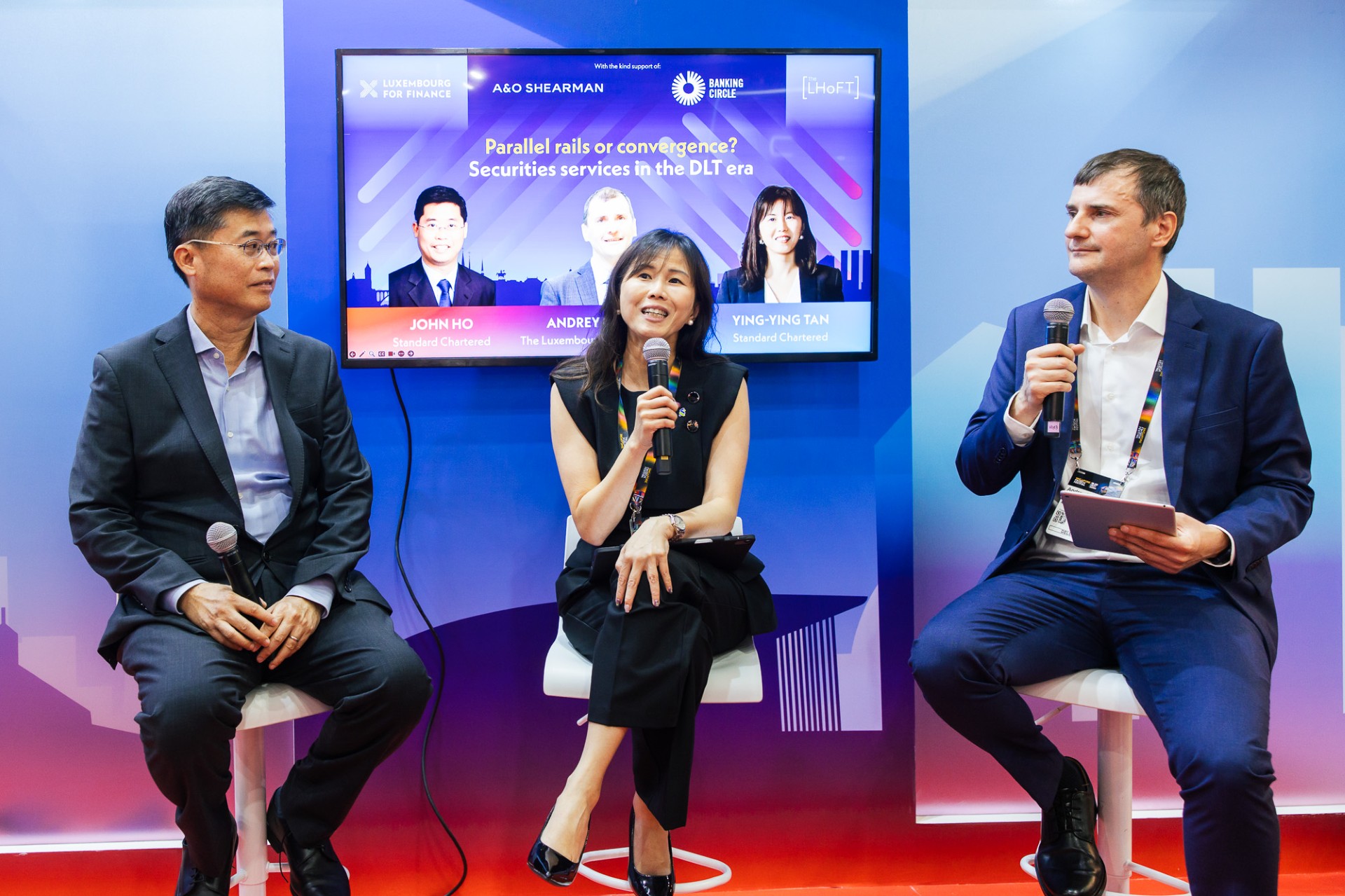 Are financial markets truly being transformed through tokenisation, or are we simply building a second, parallel financial infrastructure?
This was the central question of the second fireside chat in the ABBL’s Singapore FinTech Festival series, held at the Luxembourg Pavilion.
Moderated by Andrey Martovoy, Senior Adviser – Innovation & Digital at the ABBL, the discussion brought together Ying Ying Tan, Global Head of Securities Services and Global Head of Digital Assets at Standard Chartered, and John Hee Jung Ho, Global Head, Financial Markets Legal at Standard Chartered.
Together, they explored what it will take for distributed ledger technology to move beyond experimentation and become part of mainstream securities services.
 DLT is already delivering measurable business value
The discussion showed that distributed ledger technology is no longer only a theoretical proposition.
Ying Ying Tan shared practical examples of how DLT has already improved the economics of transfer agency operations.
Its broader potential lies in areas including faster settlement, greater collateral mobility and more efficient asset servicing, demonstrating how digital infrastructure can address real operational challenges across securities markets.


The future of securities services will not be defined by choosing between traditional finance and DLT, but by our ability to connect the two.
Andrey Martovoy
Senior Adviser - Innovation & Digital, ABBL
 Scaling tokenisation requires more than technology
Technology alone will not determine whether tokenisation reaches institutional scale.
John Hee Jung Ho introduced the BLOCKS framework, highlighting six dimensions that need to be addressed:
- Business use cases
- Legal certainty
- Ownership and custody
- Compliance
- Key technology risks
- Settlement infrastructure
Progress across all six areas will be necessary to move from individual pilots towards broader institutional adoption.
 Hybrid models are a necessary stage of the transition
Traditional and digital infrastructures are likely to coexist for some time.
Banks therefore need to support both conventional and tokenised assets while market participants, regulation and infrastructure evolve at different speeds.
Rather than viewing this coexistence as a limitation, the discussion highlighted hybrid models as a necessary phase in the transition towards more integrated financial infrastructure.
 Interoperability will determine whether tokenisation can scale
The question of interoperability emerged as a central challenge.
For financial centres such as Luxembourg and Singapore to connect more effectively, progress will be needed not only on technology, but also on legal frameworks, technical standards and compliance requirements.
Without that alignment, tokenisation risks creating additional silos rather than improving the efficiency and connectivity of financial markets.
 Looking towards 2030: convergence is the direction of travel
Looking ahead, the speakers pointed towards an increasingly interconnected financial ecosystem.
The future is likely to be multi-chain, with traditional and digital rails becoming progressively more connected.
Such convergence could create new opportunities for liquidity, programmability and cross-border financial services, while enabling market participants to benefit from digital innovation without abandoning existing infrastructure.
 Parallel rails today, convergence tomorrow?
The discussion reinforced a central message: the future of securities services will not be defined by a simple choice between traditional finance and DLT.
It will depend on the industry’s ability to connect the two securely, efficiently and at scale.
For Luxembourg, this also means continuing to engage with international financial centres such as Singapore to explore how legal, regulatory and technological frameworks can evolve together and support the next generation of financial infrastructure.
Singapore FinTech Festival 2026: Fireside Series
This article is part of a three-part ABBL series from Singapore exploring the future of financial infrastructure:
01 | Cross-border payments: making traditional and digital rails work together
Ananda Kautz, ABBL × Rahul Advani, Ripple
02 | Securities services in the DLT era: from parallel rails to convergence
Andrey Martovoy, ABBL × Ying Ying Tan & John Hee Jung Ho, Standard Chartered
03 | Connecting Luxembourg and Singapore’s financial ecosystems
Ananda Kautz, ABBL × Chek-Tchung Foo, Association of Banks in Singapore

Andrey Martovoy
Senior Adviser - Innovation & Digital, ABBL
Published on 18 November 2026