

Digital, Innovation, Payments
Many experiences, one bank: how collaboration is reshaping customer experience
Published on 19 March 2026
At its latest FinTech & Innovation Forum, the ABBL and Spuerkeess brought together banks and FinTechs to discuss how complementary digital approaches are reshaping customer experience.
Summary
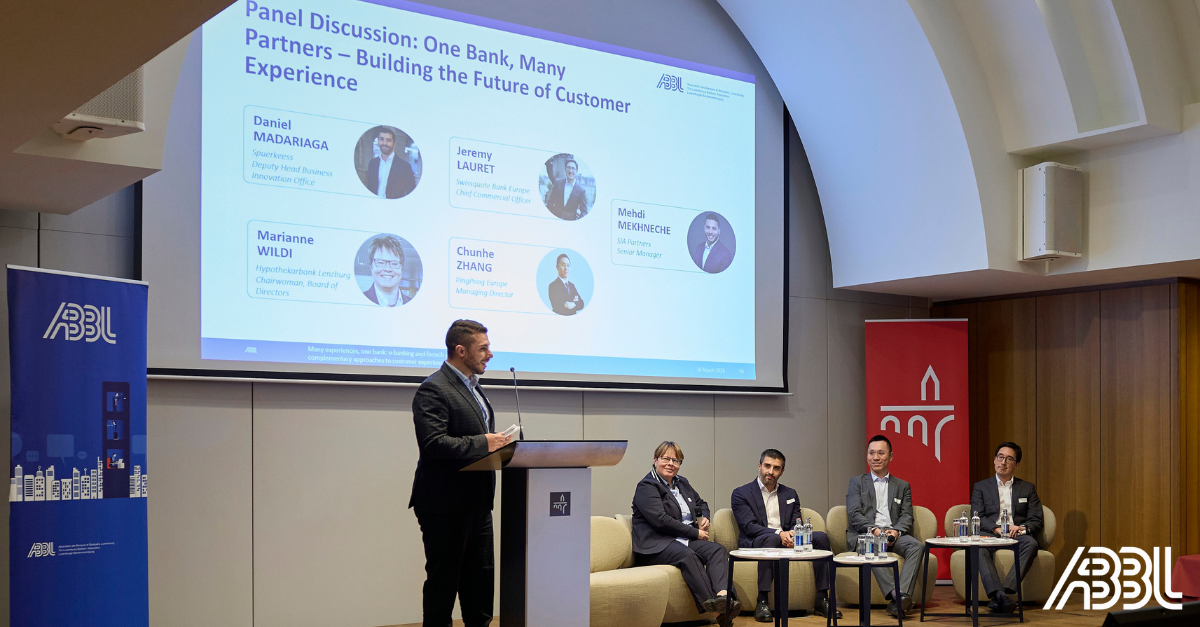 The latest meeting of the ABBL FinTech & Innovation Forum (FIF), organised in cooperation with Spuerkeess, explored how banks are combining in-house e-banking solutions with specialised FinTech partnerships to respond to rising customer expectations. Under the theme “Many Experiences, One Bank”, the discussion highlighted the strategic role of customer experience, collaboration and trust in the future of banking.
Customer experience as a strategic issue
One of the strongest messages from the event was that customer experience is no longer a secondary consideration. It is becoming a decisive factor in client retention and growth.
This is particularly relevant in the context of the Great Wealth Transfer, with an estimated USD 80 trillion expected to pass from one generation to the next over the next 20 years. Speakers highlighted that a large share of next-generation clients may reconsider their banking relationships after inheriting assets, not because of poor performance, but because of frustrating or outdated customer journeys.
This makes customer experience a key strategic issue for financial institutions seeking to remain relevant to a new generation of clients.
Innovation through collaboration
The event also underlined that innovation increasingly depends on collaboration between banks and FinTechs.
Banks bring trust, regulatory compliance, resilience and risk culture. FinTechs, by contrast, often contribute speed, specialised capabilities, infrastructure and user-focused design. Rather than opposing these models, the discussions showed how their complementarity can create more effective and scalable solutions.
This is also the logic behind the ABBL FinTech Circle, which now brings together more than 40 affiliates active in areas such as RegTech, artificial intelligence and wealth management. The objective is to strengthen dialogue between banks and FinTechs and help connect established institutions with the wider innovation ecosystem.
Designing with clients, not only for clients
Another key theme was the importance of co-creation.
Successful digital tools are not built in isolation. They need to be tested, challenged and refined with clients in order to reflect real expectations and behaviours. Speakers stressed that institutions must focus not only on adding digital features, but on designing simple, seamless and relevant journeys.
This ambition was illustrated through the idea of the “tram test”: the ability to complete an account opening and identity verification journey within the short time of a tram ride between two points in Luxembourg City. The image captured a broader point, namely that user journeys must become as intuitive and efficient as possible.
At the same time, digitalisation should also serve a second purpose: freeing up time for human expertise. By automating repetitive and low-value administrative tasks, banks can allow their specialists to focus on what matters most, namely advisory work, client dialogue and relationship building.
Security and trust remain non-negotiable
Throughout the discussions, one principle remained constant: there is no good customer experience without trust.
Convenience and usability cannot be separated from cybersecurity, fraud prevention and data protection. In a financial environment where threats evolve constantly, security cannot remain static. It must be dynamic, adaptive and embedded into the design of products and services.
Trust also needs to be nurtured more broadly:
- with customers, through reliability and transparency
- with colleagues, by supporting understanding of innovation, including AI-related changes
- with management, by creating the conditions for experimentation and learning
In this sense, trust is not only a feature of financial products. It is a core element of organisational culture.
Open banking and new value chains
The event also addressed the implications of open banking and the changing structure of financial value chains.
As financial services become increasingly embedded into non-banking journeys, the bank may operate more often in the background, while remaining responsible for security, compliance and resilience.
In this context, an API-based, modular approach allows institutions, including smaller banks, to manage a complex network of specialised partners while maintaining a strong central layer for control and governance.
This model reinforces the idea that the future of banking will not be built on one channel or one provider alone, but on the ability to orchestrate many experiences within one trusted banking relationship.
Regulation as a differentiator
A final message that stood out was that regulation should not be seen only as a constraint.
Speakers pointed out that a bank’s ability to manage the “boring” part of the value chain, namely regulation, governance and compliance, can in fact be one of its strongest differentiators when working with innovative partners.
In this respect, Luxembourg’s regulatory environment was presented as an asset. Its demanding standards reinforce trust, attract institutional capital and create a framework in which innovation can scale in a credible way.
For FinTechs, succeeding in Luxembourg can also send a strong signal of robustness and maturity.
A shared direction for the future
The discussions at the FIF confirmed that the future of customer experience in banking will not be defined by a choice between banks and FinTechs, or between human advice and digital tools.
It will depend on the ability to combine these strengths in a way that is secure, client-focused, scalable and trusted.
Through initiatives such as the FinTech & Innovation Forum and the FinTech Circle, the ABBL will continue to foster dialogue between banks and innovation players and support the development of a financial sector that remains both competitive and resilient.
Are you a FinTech interested in joining the ABBL FinTech Circle?
Explore how you can become a member and connect with Luxembourg’s banking and innovation ecosystem: https://www.abbl.lu/professionals/why-become-a-member/.

Andrey Martovoy
Senior Adviser - Innovation & Digital, ABBL
Published on 19 March 2026