

ABBL Institutional
State of the Nation address: competitiveness, innovation and attractiveness must remain Luxembourg’s priorities
Published on 22 May 2026
Summary
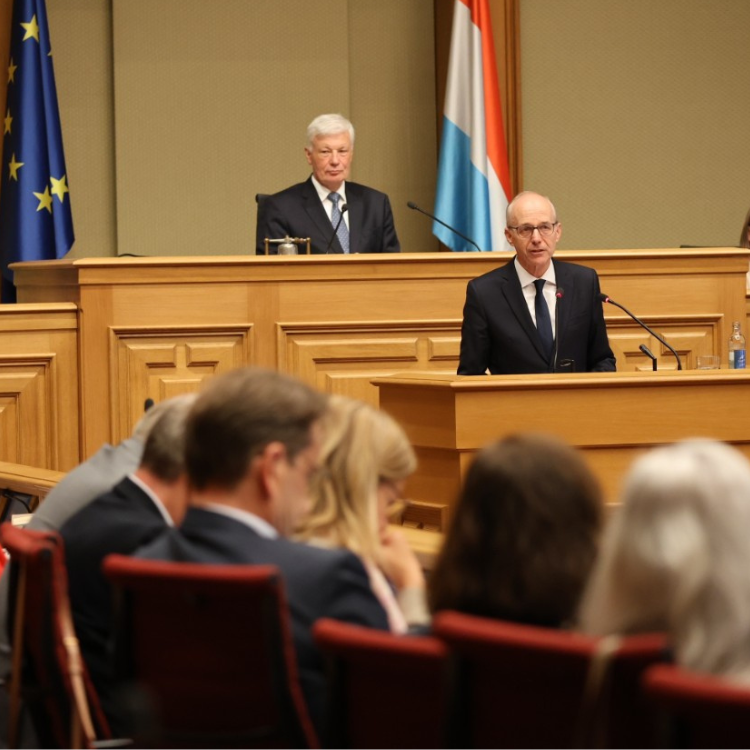 As Prime Minister Luc Frieden delivered his State of the Nation address last week, one message stood out clearly for Luxembourg’s financial sector: competitiveness can no longer be taken for granted. In an increasingly uncertain and fragmented international environment, maintaining Luxembourg’s prosperity will depend on the country’s ability to remain attractive, agile and innovative.
For the banking sector, several priorities outlined during the speech directly echo concerns the ABBL has been expressing for some time. Competitiveness, simplification, innovation, cybersecurity and talent attraction are now deeply interconnected and will play a decisive role in shaping Luxembourg’s future attractiveness and resilience.
Competitiveness and simplification: a positive signal
We particularly welcome the government’s continued commitment to strengthening Luxembourg’s competitiveness. A resilient and competitive economy requires a strong financial centre capable of financing businesses, supporting investment and accompanying economic transformation. In that sense, the prosperity of Luxembourg and the resilience of its financial centre remain closely interconnected.
The pro-competitiveness tone of the speech therefore sends an important signal to economic actors and international investors alike. At a time of geopolitical tensions, accelerating technological change and increasing international competition, preserving Luxembourg’s attractiveness requires continuous adaptation and decisive action.
Among the most significant elements highlighted in the State of the Nation address was the ambition to simplify administrative and regulatory procedures. This is a key issue for the banking sector. European banks are operating in an increasingly complex environment characterised by overlapping requirements, growing reporting obligations and fragmented implementation across jurisdictions.
For years, we have advocated for a more proportionate and efficient regulatory framework capable of supporting innovation and financing the economy. Simplification is therefore not merely an administrative exercise — it is a competitiveness imperative. As we have repeatedly highlighted at European level, Europe must move “from an accumulation of rules to a framework that is coherent, efficient and focused on real risks.”
Innovation, AI and resilience

The Prime Minister also placed strong emphasis on digitalisation, artificial intelligence and technological sovereignty. These priorities closely align with the ongoing transformation of the banking industry, where institutions continue to invest heavily in innovation, cybersecurity and digital resilience.
We welcome the government’s efforts to support the innovation ecosystem through initiatives linked to AI, fintech and digital infrastructure. Measures such as the development of the LHoFT AI Experience Center and broader support for artificial intelligence contribute to strengthening Luxembourg’s position as a forward-looking financial hub.
Equally important are the references made to cybersecurity and sovereign digital infrastructure. Operational resilience and cyber protection have become strategic priorities not only for banks, but for the economy as a whole. Maintaining trust increasingly depends on the robustness of technological infrastructures.
Talent and attractiveness remain critical

Another major theme addressed during the speech concerns talent attraction and workforce development. The Prime Minister explicitly acknowledged the growing impact of the housing crisis on Luxembourg’s ability to recruit and retain international talent — an issue we continue to raise as a sector.
For financial institutions competing globally for highly qualified professionals, housing availability and affordability have become structural competitiveness factors. We therefore welcome the government’s continued efforts to support housing development and improve Luxembourg’s overall attractiveness.
The increased focus on education, training and upskilling is equally important. As banking continues to evolve under the combined impact of regulation and technology, access to qualified talent remains essential to the long-term competitiveness of the financial centre.
Turning ambition into action

Beyond competitiveness alone, we also believe that Luxembourg’s long-term attractiveness depends on maintaining a balanced and sustainable social model. Attracting and retaining talent requires more than economic performance: it also depends on housing, education, training opportunities and quality of life. This is why we continue to engage constructively in discussions on labour market adaptation, skills development and broader structural reforms.
At the same time, the challenges facing the banking sector should not be underestimated. Banks are operating in an environment marked by rising compliance and operational costs, increasing regulatory complexity and growing international competition. While the sector remains resilient, the continued accumulation of constraints risks progressively reducing banks’ capacity to finance the economy and invest in future growth.

Luxembourg’s future attractiveness will therefore depend on its ability to preserve the right balance between cost of doing business, agile time-to-market and a stimulating working environment.
Jerry Grbic
CEO, ABBL
In a highly competitive international landscape, maintaining Luxembourg’s ability to attract international capital, high value-added activities and specialised talent — while retaining strategic functions, expertise and decision-making centres — will be essential to preserving the long-term competitiveness of the financial centre.
We must also remain attentive to the evolving structure of the sector itself. The growing weight of regulatory and operational requirements is progressively shifting resources away from commercial and value-generating activities.
The State of the Nation address reflects a growing awareness that competitiveness, resilience and innovation are closely interconnected. We welcome this recognition. But maintaining Luxembourg’s leading position will require more than ambition alone: it will require rapid implementation, continued structural reforms and a constant focus on preserving the conditions that allow businesses, talent and investment to thrive in Luxembourg.
Jerry Grbic
CEO, ABBL
Published on 22 May 2026